Walking
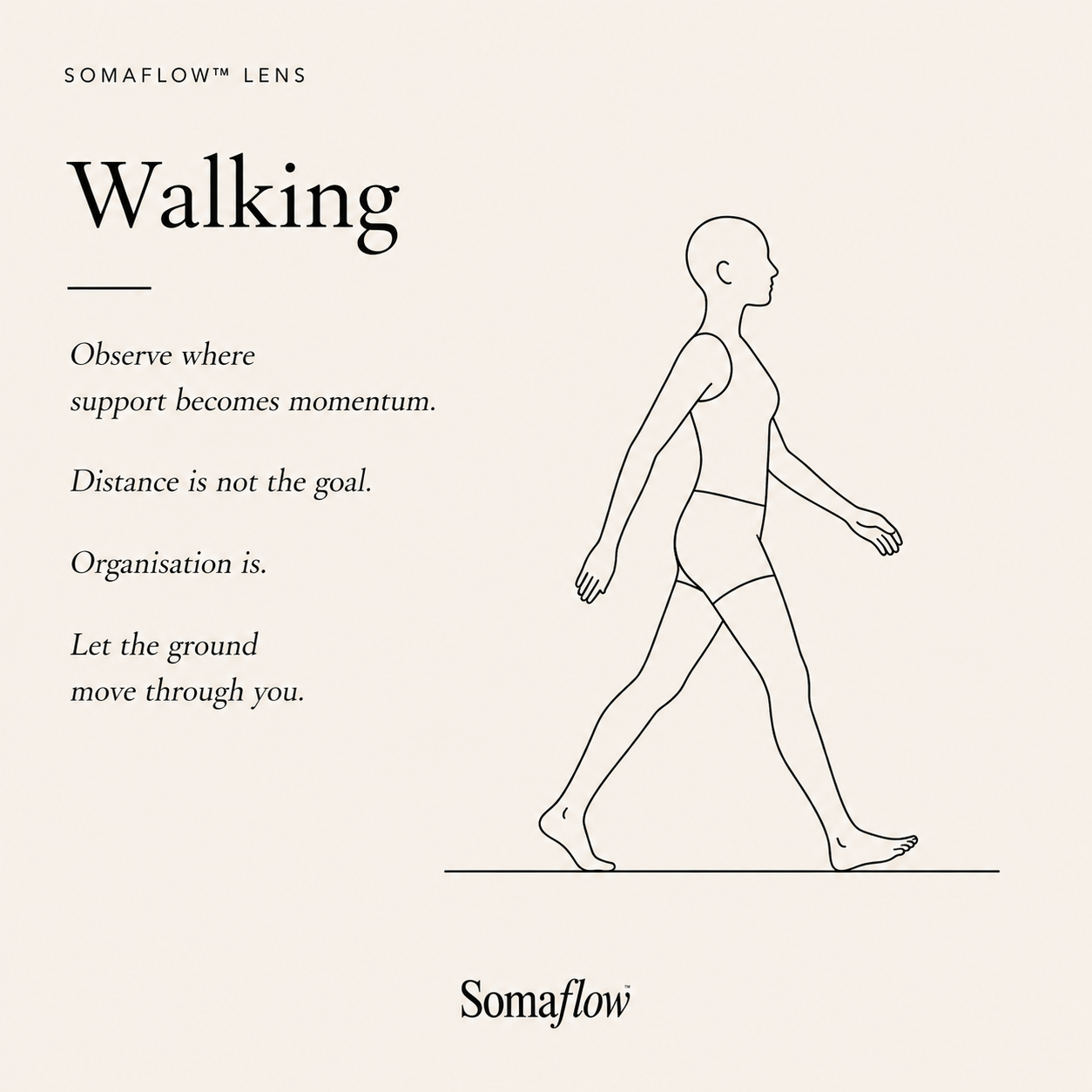
Walking through the SomaFlow Lens
Walking is often described as one of the body’s most natural movements.
The SomaFlow Lens begins with a different observation.
Walking may be one of the richest places to observe the body’s capacity to adapt.
Because walking is essential.
The body cannot simply stop moving through the world because support has changed, a joint has become less available, the pelvis is no longer responding clearly, or one part of the system has begun contributing less.
It finds another way.
Weight shifts somewhere else.
The stride shortens.
The feet turn outward.
The upper body stiffens.
The shoulders begin helping.
Momentum replaces propulsion.
One part of the body works harder so that walking can continue.
These adaptations are not evidence that the body has failed.
They are evidence of its intelligence.
The body has solved the problem of keeping us moving.
But because walking is repeated thousands of times, the solution can gradually become the pattern.
And because walking is largely unconscious, we may no longer recognise it as an adaptation.
It simply becomes the way we walk.
Modern walking is also often shaped by destination.
We are going somewhere.
We are in a hurry.
We lean forward, fall and catch ourselves, allowing momentum to carry us from one step into the next.
The feet keep moving, but the relationship through the body becomes less available.
The upper body may hold tension.
The pelvis may travel through space without fully organising the movement.
The posterior chain may contribute less than it could.
Rather than asking whether walking looks correct, SomaFlow asks a different question.
What has the body learned to do in order to keep walking?
Then we begin again with support.
Every step starts with the ground.
Support enters through the foot and travels into the back of the leg.
The hamstrings receive.
The glutes organise.
The inner thighs create relationship across the pelvis.
Together, the hamstrings, glutes and inner thighs form the Pelvic Triangle—the body’s primary centre of support and propulsion.
The Pelvic Triangle does not simply push the body forward.
It receives support from the ground, organises that support through the pelvis, and creates the conditions for propulsion to emerge.
As that relationship becomes clearer, the posterior chain begins participating more fully.
The pelvis becomes responsive rather than passive.
The spine no longer has to manufacture movement.
It responds to the movement created beneath it.
The ribs rotate.
The arms join the conversation.
The head is carried rather than held.
Walking becomes a whole-body relationship between the ground, the Pelvic Triangle and everything organised above it.
The movement may become quieter.
The stride may become shorter before it becomes longer.
The body may move more slowly while it begins noticing support again.
That is not regression.
It is reorganisation.
Speed is not the measure of successful walking.
Distance is not either.
A person may walk quickly and cover great distances while relying on one highly rehearsed strategy.
Efficiency can keep us moving.
But efficiency is not always the same as capacity.
SomaFlow is interested in how much of the body remains available within the movement.
Can the foot receive the ground?
Can the posterior chain participate?
Can the Pelvic Triangle organise support into propulsion?
Can the spine respond?
Can the arms and ribs communicate with the pelvis?
Can the body adapt without reducing walking to falling forward and catching itself?
Walking reveals the patterns the body has developed through repetition.
It also gives us an opportunity to begin inviting something else.
Not by correcting every step.
Not by forcing a particular gait.
But by restoring awareness of the support that has been there all along.
Walking is simply the environment.
The body’s intelligence is already present.
Organisation is the practice.