Double Leg Lower
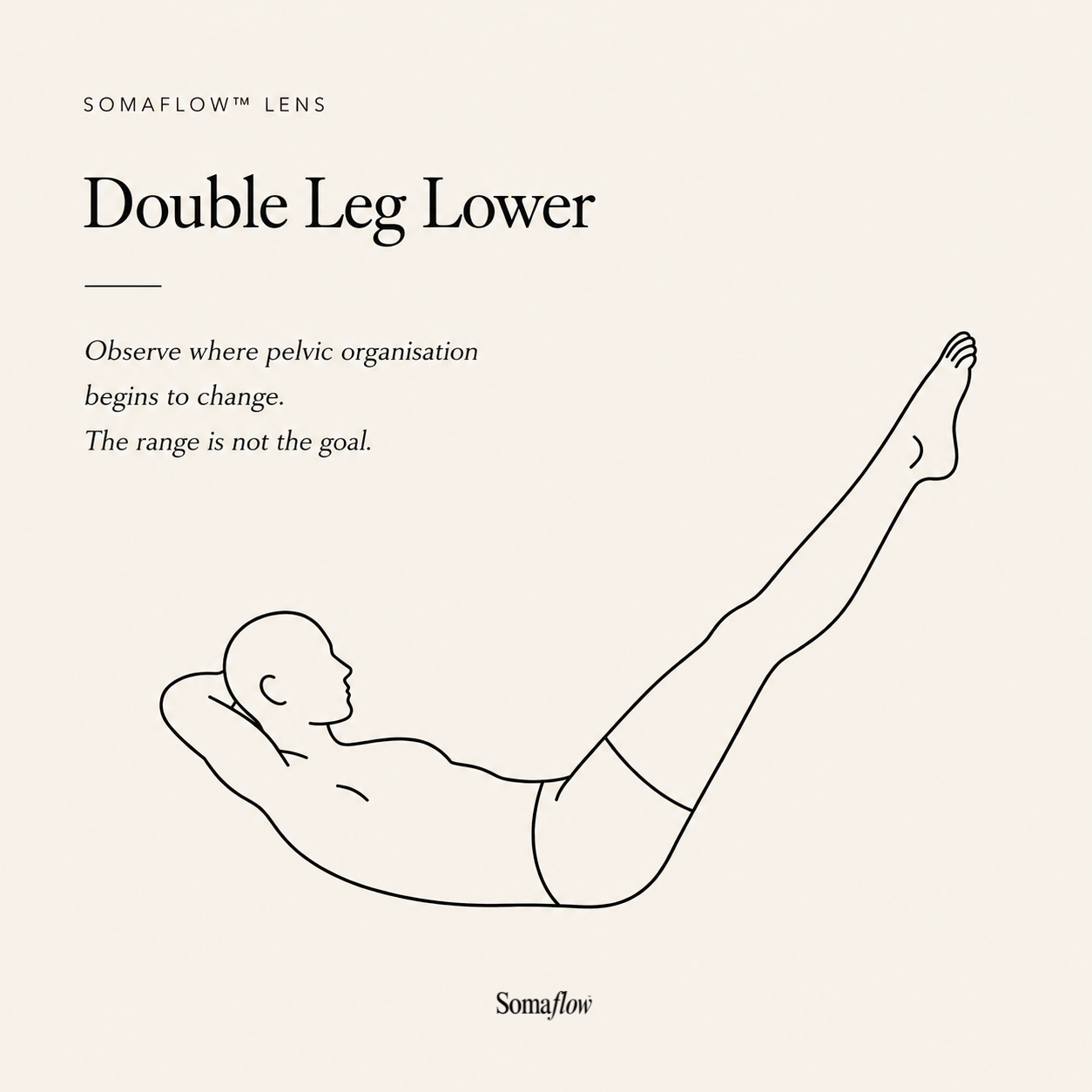
Lower back discomfort during Double Leg Lower?
Many movement systems explain this by saying the abdominals aren’t stabilising the pelvis well enough.
SomaFlow asks a different question.
What is organising the pelvis?
Rather than treating the pelvis as something the abdominals must stabilise, SomaFlow recognises the pelvis as the body’s primary organising centre.
The abdominal wall is not responsible for organising the pelvis.
It responds to pelvic organisation.
Stability doesn’t begin with gripping.
It emerges through organisation.
Before the abdominal wall can respond efficiently, the body needs something to organise around.
Support through the Pelvic Triangle.
Pressure through the Pelvic Bowl.
A coherent relationship with the ground.
When these relationships become organised, the abdominal wall no longer has to create stability.
It becomes an expression of an organised system.
This is why lowering your legs further isn’t always the goal.
If the body begins borrowing movement from the lumbar spine, gripping through the hip flexors, or losing pelvic organisation, you’ve simply moved beyond the conditions your body can currently organise.
In SomaFlow, we don’t ask,
“How low can you go?”
We ask,
“Can pelvic organisation be maintained as the movement becomes more demanding?”
Because stability isn’t something you manufacture by squeezing harder.
It emerges when the pelvis is organised, and the rest of the body is free to respond.